BY LAUREN APGAR
Editor’s note: At MeaningSphere, we believe that meaning at work matters and that it’s deeply personal. This series highlights diverse perspectives across the 10 core fulfillment areas from our Worklife Fulfillment Indicator. Each piece reflects the author’s own experience, with the goal of sparking reflection and dialogue.
The state of your worklife can sometimes feel like the unrelenting winter we just endured in the Northeastern United States: overwhelming, uncontrollable, and something you simply have to get through.
I tried my best to lean into the colder, darker, slower season. I read books on hygge—the Danish and Norwegian concept of infusing everyday life with as much coziness as possible. I worked on art projects. I did my best to stay active and see friends. But as someone who views time in nature as a foundational element of stable mental health, not being able to go outside much this winter started to make me feel deeply stuck. I knew time in nature would be good for me, but it just couldn’t happen…yet.
On feeling stuck—at work and in life
Your worklife can make you feel this way, too. Sometimes you deeply crave a much‑needed change at work, knowing it would improve so many other aspects of your life, but the desired transition is slow in coming. Whether the limitation is financial, familial, or simply the reality of a tough labor market, the unpredictability and uncertainty of when that change will come takes time. And that time—the waiting—can take a toll on you, much like being unable to get outside during winter. So how do you keep looking for moments of spring when you’re in the winter of your worklife?
At one point this winter, I had to acknowledge and accept that these were simply the limitations of the season. If I couldn’t change the weather, maybe I could change my perspective. Instead of just enduring the cold days, I started thinking about what I wanted and hoped would happen when spring finally decided to roll around. I began going to the gym more so I could tackle a tough hike the moment the weather improved. I bought planters while there was still snow on the ground, so that when the first warm week arrived, I could head straight to the plant store. At the time, I didn’t know if this mindset shift would help my winter blues at all. I just had to sit in the discomfort and uncertainty of it, and hope something might come of it.
Subtle mindset shifts make room for change
What if you’re in the winter of your worklife right now and you know you can’t leave? What could you do today to shift your perspective in the simplest, most minuscule way? What could you add to your own “look forward to spring” list during this season of your career?
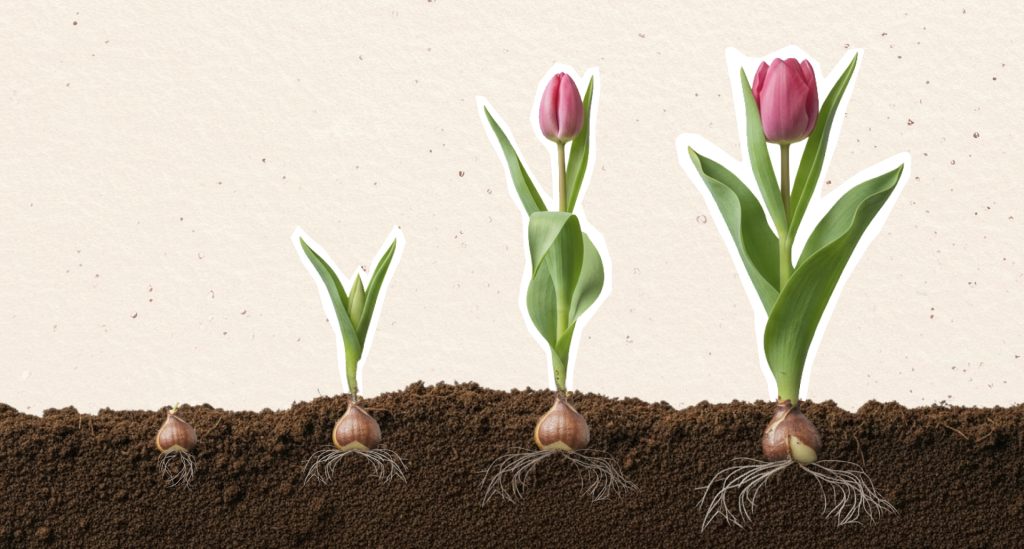
One day, I remembered that back in the fall, my partner had planted several tulip bulbs in our garden for us to enjoy in the spring. Slowly, I started to notice small green stems pushing up through the dirt. It felt like hope. It’s taking time, but the tulips are growing. The seasons are changing. Change is good. Growth is good.
Seeing those tulips got me thinking about growth in general, and how essential a growth mindset is in both our personal and professional lives. Broadly speaking, a growth mindset is the understanding that our knowledge and skills are fluid—that we can learn new things, change, and adapt. Our abilities aren’t fixed or static; they can be adjusted. I find that deeply refreshing, especially when so much messaging out there can make it feel like your identity is fixed and change is impossible.
Applying the “growth mindset” in my own life
If you know me personally, you know how much I value cooperation, collaboration, and harmony. I want everyone to feel heard and to feel like a stakeholder in whatever we’re working on together. I don’t need control, and I don’t need to be the leader or expert. I want people in my orbit to feel empowered by the space my energy and actions help create.
While those attributes are important in work—especially for me, as a Leadership Consultant and Project Manager—they can also make things harder. For example, while working on a project for a high-profile healthcare client, I missed the mark when it came to speaking up about my hesitations around an aggressive timeline. I didn’t want to disrupt the harmony of the team. I felt deeply uncomfortable being the contrarian who says, “I don’t think this is possible or feasible,” even when I had the expertise and agency to do so.
When I debriefed the situation with a mentor, he told me that sometimes you have to step outside of yourself to get the job done. I needed to be more assertive and direct with my clients—even if it felt uncomfortable, even if I didn’t know what the outcome would be. He told me, “You have to grow through what you go through.” I couldn’t change the fact that the project was late, but I could learn from it—even if it was uncomfortable, even if the outcome remained uncertain, much like my winter‑to‑spring mindset shift.
Growth is not linear
I’ve come to realize that truly adopting a growth mindset means accepting that growth is not linear. I wish I could tell you that I am now a professional at being assertive and direct with clients. I wish I could tell you that this same situation hasn’t happened again. But it has. You will probably backslide on things you’re trying to grow out of or grow into. You may have to relearn the same lesson more than once. I know firsthand how frustrating those hard‑earned, repeat lessons can be. To go back to our tulip analogy, you might do everything right in the fall, and still find that—for some reason—the bulbs don’t come up in the spring.
But when things aren’t sprouting in our lives, a growth mindset can snap us out of the trance of disappointment. By choosing to catalog the lessons learned and alchemize them into growth, you take some power back—creating a bit of agency and even the tiniest sliver of control in an otherwise uncontrollable situation. At the heart of a growth mindset is the belief: Even if it takes time, and even if there are many unknowns, I am going to learn to do this.
Just like tulips, you can’t rush your own growth. It takes time, patience, and quiet preparation. And that belief alone can feel reinvigorating—much like seeing the very first bulbs of spring.
***
Lauren Apgar is a former higher education professional, current leadership consultant and project manager, and overall outdoor enthusiast.