BY MEANINGSPHERE STAFF
Recently, the president of a recruiting company in Florida shared a minor piece of advice that ignited a fierce generational debate. In a TikTok video, she advised Gen Z job candidates not to bring an iced coffee to an interview: it’s unprofessional. The responses to her now-viral take, which was based on her own observations working with younger candidates, tended to fall into one of two camps. Either Gen Z workers were lazy, clueless, or careless—or the older generations were too rigid, fixated on arbitrary details around beverage decorum rather than a candidate’s skills or qualifications.
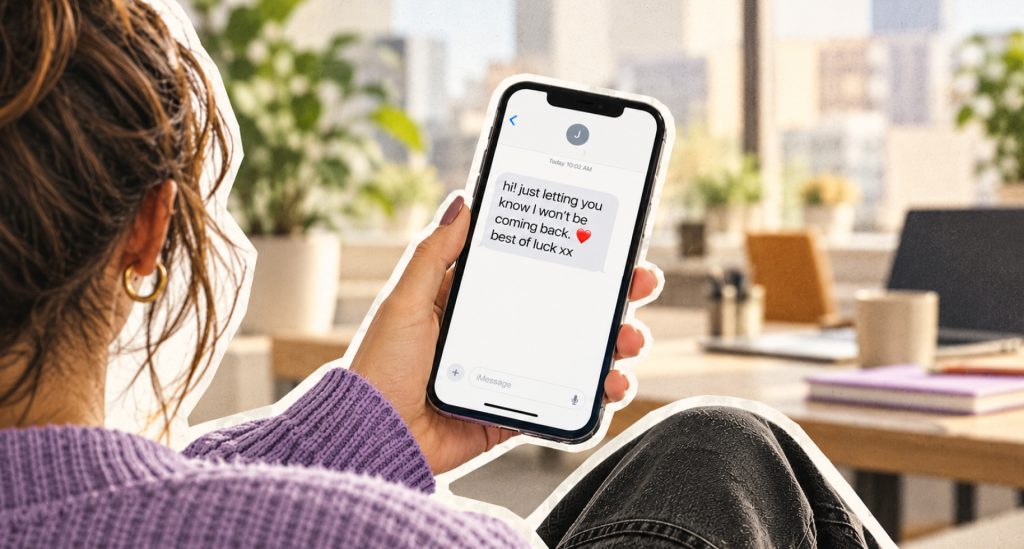
“The Great Iced Coffee Debate of 2026,” as it has been dubbed online, isn’t the first example of Gen Z folks—those born roughly between 1997 and 2012—being criticized for resisting traditional workplace expectations. A trend of younger workers quitting their jobs in increasingly blunt ways is also getting significant attention on social media. Most of these resignation notices take the form of a short, spicy text message: “This place is toxic and I am not strong enough to romanticize suffering,” one says. Others put a more creative spin on things. One note, handwritten on toilet paper, reads “I have chosen this type of paper for my resignation as a symbol of how this company has treated me.”
It’s easy to be shocked or entertained by these types of headline-grabbing moments. But what if the same things employers criticize about Gen Z turn out to be clues about what makes work feel worthwhile—and what can happen when it doesn’t?
It’s a tough time for young professionals to find work of any kind—let alone work that is both financially sustainable and personally fulfilling. Last spring, just as the class of 2026 was preparing to graduate, the New York Times warned that new grads were facing the most dismal job market in years. What looks like apathy or carelessness from the outside may in fact be a symptom of this generation’s untapped potential within the workplace.
To that end, here are a few findings that may surprise you.
Gen Z workers actually want more time in the office
You’re reading that right. A recent Gallup study showed that the generation most associated with remote work are least likely to prefer a fully remote lifestyle. The reason? In-person work fosters mentorship, connection, and career growth—while staving off loneliness among the newest hires.
A 2025 Deloitte survey supports this: 86% of Gen Z respondents said mentorship and guidance were important to their development, and 88% said they value hands-on learning and practical experience.
Importantly, this generation is also invested in developing the interpersonal skills workplaces need: 43% of Gen Z respondents to EY’s 2025 U.S. Generation Survey said they had focused on improving their emotional intelligence over the previous year. Gen Z is already invested in the kind of “soft skills” most workers develop after many years of experience in their field.
They are actively invested in their own development
This is a powerful counterpoint to prevailing stereotypes. The same Deloitte study found that a majority (70%) of Gen Z respondents are actively developing their professional skills every week, and an overwhelming majority of those who said yes are also doing so outside their working hours.
Clearly, Gen Z does not lack ambition. They are building toward a career that fits them—even if they have to play the long game to get there.
They want to make a positive difference through their work
Younger workers are often portrayed as being motivated by personal gain, but this could not be further from the truth. In fact, 79% of Gen Z respondents to the 2026 Harvard Graduate School of Education, Gallup, and Walton Family Foundation study said they want a future job focused mainly on helping others or making a positive difference in people’s lives.
There’s just one problem: The research also found that only about half of 18– to 29-year-olds who wanted this kind of work said they currently had it, an important reminder that aspirations and available opportunities don’t always line up.
What we can all learn from Gen Z
It’s easy for generational rifts to form in the workplace, especially when the cost of living is rapidly rising, and competition for jobs is already tough. But rather than direct our frustration at younger workers’ “unhinged” habits, it’s worth seeing these behaviors as evidence of what can happen when meaningful work feels out of reach. After all, the data shows that Gen Z workers want to build connections, find mentors, develop both “hard” and “soft” skills, and ultimately have a positive impact on other people through their work. The problem isn’t a lack of motivation—it’s a lack of access to the kinds of professional opportunities we all need to craft a fulfilling worklife.
It’s also worth remembering this: the norms of the youngest generation are frequently baffling to the previous one. Does the younger generation have a clue what to wear, at work or otherwise? Absolutely not, at least according to the latest opinion article. Do they have a vastly different idea of workplace etiquette than their older peers? Of course they do, and so did the generation before them.
Does iced coffee have any place in a job interview? We’ll have to agree to disagree.