
BY MEANINGSPHERE STAFF
Does your work fulfill you?
If you answered yes, how do you know? And if you answered no—or weren’t sure—consider this: what would “fulfilling” work look like?
Fortunately, we created a free tool to help you answer these questions. We call it the Worklife Fulfillment Indicator. It works by organizing your current experience of work into 10 core fulfillment areas, such as Growth, Impact, and Connection. Once completed, you’ll have a useful snapshot of your current worklife, highlighting what’s working well and what’s missing.
*
Who is it intended for?
The Indicator is designed to help you spark awareness about your needs at work. It’s for anyone struggling to put their finger on what exactly makes one job fulfilling and another unfulfilling. Here are a few candidates:
The “Sunday Scaries” sufferer: Your job is great on paper, so you can’t figure out why you get that vague sense of dread as the sun goes down on a Sunday evening. If that’s you, this tool can help you name what’s missing.
The burnt-out box-checker: You’ve been running on adrenaline at work, garnering praise for completing every task and never missing a deadline. Burnout is starting to seep in—but so far, you’re too busy to notice. The Indicator can help you spot the drain on your energy before it’s too late.
The side quester: You’re demotivated at work—but somehow, you turn into a productivity machine as soon as you pick up one of your hobbies. What’s missing at work that these “side quests” provide—Inspiration? Autonomy? Connection? This tool can help you identify it.
If any of these situations sound familiar, you might benefit from taking some time out to check in with your professional wellbeing. The Indicator can’t tell you what to do—it simply presents you with a snapshot of your levels of fulfillment at work. Think of it like your car’s dashboard—when you’re running out of gas, your fuel gauge doesn’t tell you to stop at the next station. It simply points to “E.” Yet this information alone is valuable—and you can make the informed next steps from there.
Many people who’ve taken the Indicator say the experience helped them validate and clarify their unspoken needs at work. They’ve shared feedback like this:
“The feedback gave me a sense of validation.”
“I think it is extremely important that our career add value to our lives and this indicator helps to clarify to what extent the current career is doing that.”
“It is great to see what is missing or working for you, clearly, concisely and on paper.”
Bottom line: if you want to make sense of your experience at work so you can start taking charge of your professional wellbeing, this tool is for you.
With the Worklife Fulfillment Indicator, you’ll only focus on what’s important
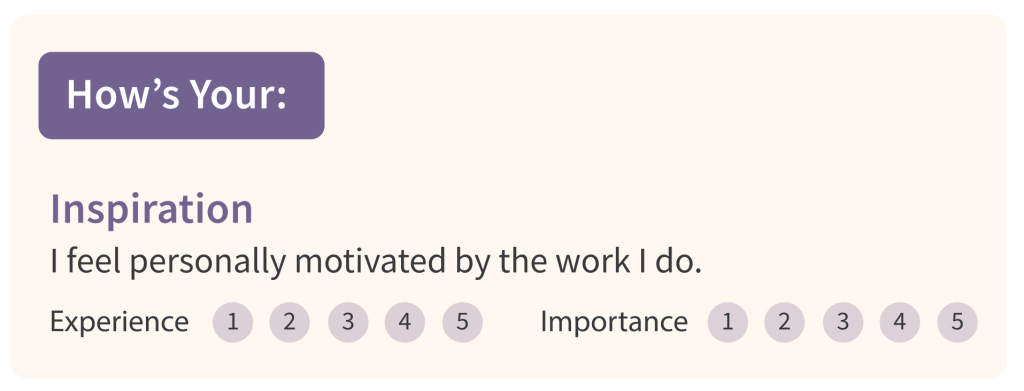
For each fulfillment area, you’ll respond to a statement about your current experience of work, giving it a score from one to five. (One means “I totally disagree” and five means “Yep, that’s me!”)
Here’s the thing: in addition to rating your experience in this area, you’ll also rate how important this item is to you.
For example, let’s say you work in an environment where there are detailed processes and protocols in place. Perhaps you assemble complex machinery or run tests in a laboratory. You might arrive each morning with the parameters of the day’s tasks clearly set for you. In this case, you might rate your experience of “Autonomy” as fairly low, since you aren’t in control of your day-to-day tasks, and aren’t required to make many big decisions.
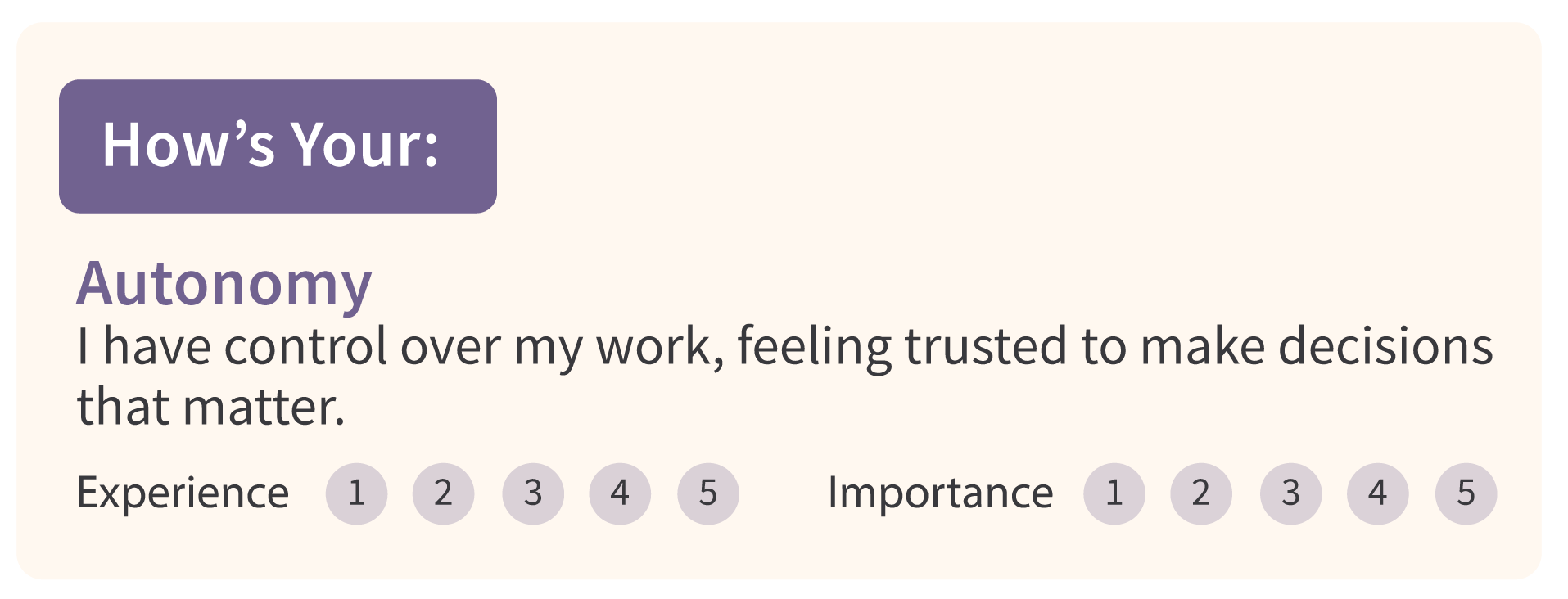
Is a low Autonomy score a problem? Only you say so. One person may thrive in a structured environment with clearly defined processes and objectives, while another may feel stifled. By rating the importance of this area on a scale of one to five, you can determine how much Autonomy matters to you at work.
Who is it not intended for?
We know that some of you are already acutely aware of what you need (and don’t need!) at work. You may be thinking, “Look, I already know what’s wrong. I don’t need a tool to remind me!” Or even, “My job is awesome. I don’t need an assessment to tell me that!”
If you already have a clear sense of what’s working (and what isn’t) in your worklife, you may not need a tool focused on awareness.
Instead, if you’re looking to create lasting change in your professional life—or simply understand yourself on a deeper level—we recommend starting with the Worklife Fulfillment Builder. Backed by academic research and based on a proven framework, the Builder was designed to help you identify your core drivers of meaning, reflect on what you’re learning, and ultimately to design a worklife aligned with what matters most to you.
Why is fulfilling work so important, anyway?
We spend a huge chunk of our time and energy working. Yet all too often, we stumble in and out of fulfilling work almost by accident; realizing only after the fact whether a role was truly meaningful to us or not. We may happily accept a promotion only to find that the new gig takes us away from the activities we love and leaves us feeling empty—but in a slightly nicer office. We might follow our passion into a job with an inspiring mission, but find that the day-to-day dynamics exhaust and frustrate us. On paper we may be a perfect fit for the role. But how to make sure the role fits us?
We created the Indicator to help working people start to bridge this gap for themselves. It’s not a quick fix by any means: the task of designing a fulfilled worklife is never complete. Rather, this tool provides a simple framework and vocabulary to help you notice your needs and priorities at work. It just may be the first step toward a professional life that feels authentically yours.
***